
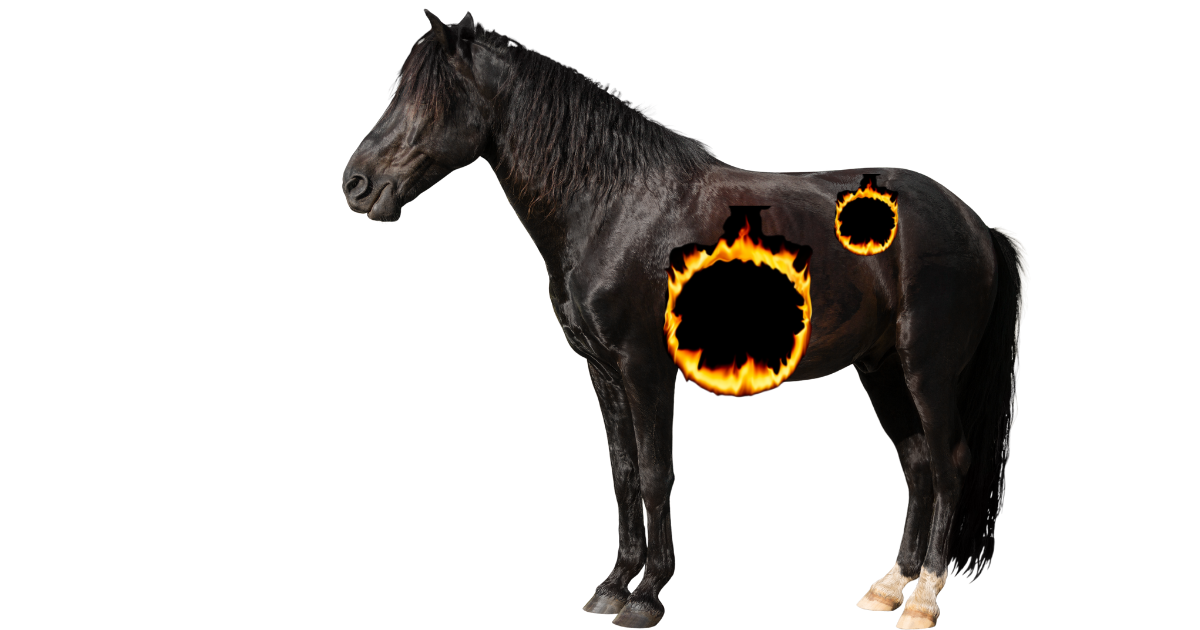
Ulcers in horses: recognizing the signs because they suffer in silence
A horse that becomes irritable, even aggressive and tries to bite you while grooming.
Another one refuses the girth or lays its ears back when the saddle is approached.
A nervous mare, who constantly swishes her tail or grinds her teeth.
What if these behaviors were not "characteristic"... but the expression of digestive pain?
Today, it is estimated that a large proportion of horses — up to 80% in certain contexts (competition, too long a stay in a box, transport and travel) — can develop gastric or duodenal ulcers, sometimes without obvious signs at the start.
Learning to recognize them early helps prevent discomfort from becoming a long-term problem.
When behavior becomes a warning sign
Ulcers do not always manifest themselves with obvious and clearly visible signs.
Very often, subtle changes appear:
- Aggression during meals
- Sensitivity to the strapping
- Defense during grooming (biting, tail swishing, kicking)
- Decrease in performance
- Unusual irritability or anxiety
These reactions are often misinterpreted as parenting problems… when they sometimes reflect very real pain.
Understanding the horse's stomach: a natural vulnerability
The horse's stomach is divided into two zones:
- An upper (non-glandular) part: very sensitive, without natural protection
- A lower (glandular) part: protected by mucus and physiological mechanisms
The problem ?
The horse produces gastric acid continuously… even when it is not eating.
👉 In the wild, it spends up to 16 to 18 hours a day feeding.
👉 In modern conditions (boxes, spaced-out meals, stress), the stomach remains empty for longer.
Result :
- The acid attacks the fragile mucous membrane
- Acid spray increases with exertion
- The lesions appear gradually
Glandular ulcers, on the other hand, are more closely related to:
- au stress
- to dehydration
- to rations rich in sugars
Signs to watch for on a daily basis
Certain clues are particularly revealing if you take the time to observe:
- Worn or ruffled fur behind the shoulders (self-biting)
- Chewing without food, frequent licking
- Teeth grinding
- Loss of condition or difficulty maintaining weight
- Mild and recurring colic
- Lack of energy
- Horse that drinks less
- Unusual stretching postures
👉 In summary:
A horse that is no longer "comfortable in its own skin" deserves our attention.
Diagnosis: a key step
The only reliable method to confirm the presence of ulcers is:
👉 gastroscopy performed by a veterinarian
It allows for direct visualization of the lesions and adaptation of the treatment.
However, in practice, it is common to try to quickly relieve the horse while waiting for:
- the availability of the veterinarian
- or the possibility of taking the exam
Clay: a natural approach to soothe the digestive mucosa
Green clay used internally acts as a natural gastric dressing.
Its main actions:
- It lines and protects the mucous membrane
- It adsorbs toxins
- Helps regulate acidity and pH
- Promotes an environment conducive to healing
👉 In many cases, an improvement in comfort can be observed quickly.
Practical advice
- Mix into the daily ration (for a horse of approximately 1000 lbs: 2 x 2 tablespoons or 1 x 4 tablespoons if you are giving the minerals once a day)
- Adjust the duration according to the condition and severity of the horse's ulcers
- If taking medication, leave a 2 to 4 hour gap between taking the medication and the medication.
⚠️ Important:
Clay supports digestive comfort, but does not replace veterinary care when necessary.
Prevention is better than cure: the essential basics
Ulcers are rarely linked to a single cause.
They result from a combination of factors.
1. Food
- High-quality, dust- and mold-free hay available continuously (ideally in nets) or good, not-too-rich grass in the pasture
- Eliminate long periods of fasting. We now know that horses are supposed to eat for 16 to 18 hours a day.
- Reduce sugar-rich concentrates, reduce or even eliminate supplements, sometimes distributed year-round and not always essential for good health.
- REMINDER: The best way to determine your horse's nutritional deficiencies is through a blood test and a body condition score assessment. A professional can then establish a suitable diet based on its activity level. An athletic horse does not have the same needs as a companion horse.
👉 Forage remains the best natural protection for the stomach.
2. The environment
The horse is a herd animal.
- For his mental well-being, he needs a stable and harmonious group life.
- Access to a paddock, or better yet, a pasture, is absolutely essential for him.
- The reduction in stress will undoubtedly be noticeable.
👉 Mental well-being directly influences digestive health.
3. The challenge of transport and competition
Travel is a risky time:
- Stress due to travel, change of environment, noise
- Changes in diet and schedules
- Disrupted and probably reduced hydration
The best practices you are familiar with:
- Bring your usual hay
- Maintain good hydration (using familiar water)
- Monitor and support the digestive system and intestinal transit
- Perform the dehydration test and monitor the color and condition of the gums (CRC).
An essential, comprehensive approach
Ulcers are not just a stomach problem.
They are often a reflection of:
- lifestyle
- you stress
- of the overall management of the horse
👉 Relieving symptoms without addressing, or better yet, eliminating the cause, often leads to a relapse. Regardless of the treatment product, ulcers heal but will reappear in the same place or elsewhere if the underlying cause is not eliminated. This is also why many competitors use internal clay to support this balance during the competition season and only administer three-week courses of treatment in the fall, winter, and spring, provided there are no symptoms, of course.
Key points to remember
✔ Changes in behavior are often signals of pain
✔ Due to its small size, the horse's stomach is naturally vulnerable
✔ The prevention of ulcers, like many other health problems or behaviors, relies on diet, environment, and stress management.
✔ Natural solutions, among others, such as seasonal 3-week internal clay treatments, can effectively support digestive comfort and, in the case of existing ulcers, will help to heal them.
This English video by Dr. Mark DePaolo demonstrates how to test some pain points related to ulcers.
Here is the link: How do I know if my horse has ulcers?